

Pragmatic Organization Dynamic Display
What is PODD?
A comprehensive communication system that provides a means to express thoughts, feelings, and ideas when speech alone isn’t enough.
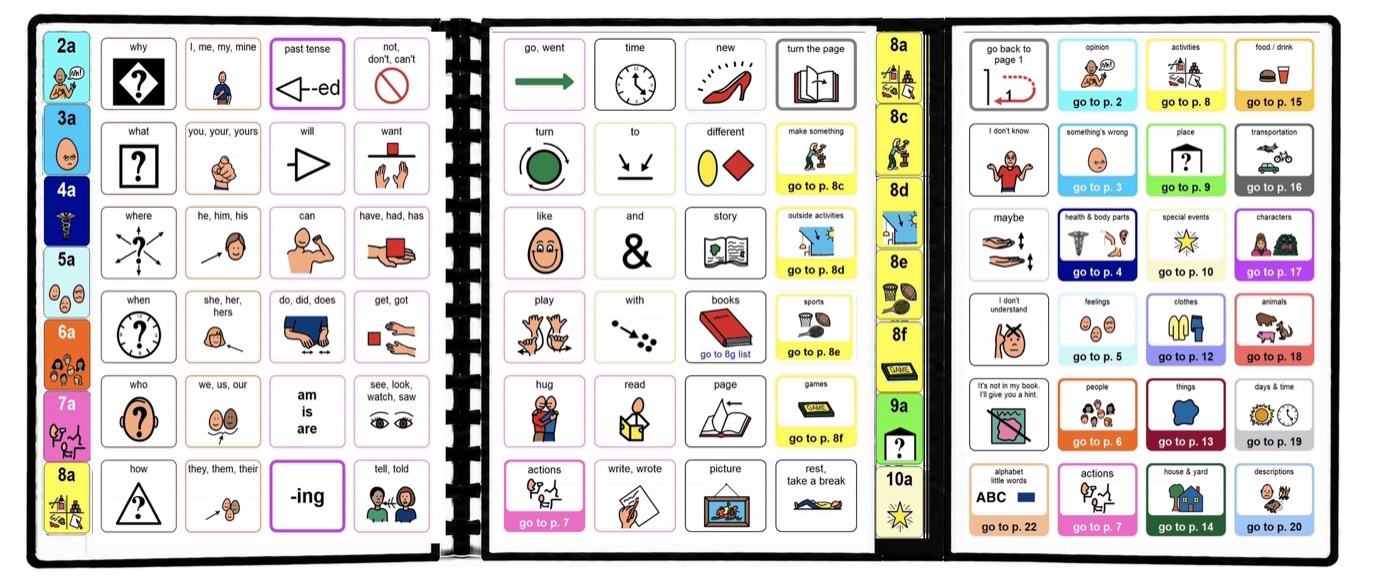
A way of organizing language, not just a set of pages
PODD is a way of organizing language—not a particular device, app, symbol set, or communication book.
The organization itself is the point. How language is laid out determines whether someone can reach the vocabulary they need right now, and whether the system keeps supporting them as their communication and language develop. A display that only holds a handful of preselected choices limits what a person is able to mean.
“a child who uses speech will independently select the words she wishes to use from the vast array of words she hears/sees used every day. A child who uses AAC will independently select the words she wishes to use from the vocabulary other people have chosen to model and, for aided symbols, made available for her to use.”
Porter & Kirkland, 1995, p. 93–94. This is the problem PODD was designed to solve.
Language that grows with your child
PODD provides a systematic range of language levels, from early words to complex sentences and conversation. Each level supports current communication needs while introducing language for the next stage of development.
Skills learned at one level are built upon in the next, with familiar organizational principles and navigation patterns carried forward. This continuity helps children expand their language without having to relearn the system's organization as they progress through language levels.
Organized for language usage patterns and discourse
PODD groups words that are likely to be used together, called predictably associated vocabulary, to make building multi-word messages more efficient, with fewer page turns or screen changes.
Vocabulary for the next part of the conversation is also anticipated, often allowing communication partners to respond using the same page to keep the exchange flowing naturally.
Optimized for a range of access modalities
There are three versions of PODD organization, and all of them span the full range of language development.
Direct access
For individuals who can point to symbols directly.
Alternative access
For individuals who can visually access symbols but cannot point effectively.
For example: visual scanning, eye-gaze, coded access, and combination access.
Alternative presentation
For individuals who have visual challenges and require visual differences in presentation — reducing the complexity of the display, increasing differentiated symbols, and adding auditory supports.
For example: auditory scanning, auditory-plus-visual scanning, and direct access with or without auditory supports.
What makes PODD different
Principles inherent in the design of PODD
Organized by Pragmatics and Discourse
PODD organizes vocabulary around why we communicate and what we might say next. Whether someone wants to ask a question, share an opinion, object, or tell a story, the layout helps them find words that fit their purpose and continue the conversation. This attention to communication purpose and conversational flow is what pragmatics and discourse bring to PODD’s design.
Designed for the Intervention Strategy of Aided Language Stimulation
PODD is specifically designed to support aided language stimulation, where communication partners point to symbols as they speak during everyday interactions. Each language level includes vocabulary for the individual’s current communication needs, alongside words and language structures that partners can use to model slightly more complex messages. This allows partners to naturally expand on what the person communicates, supporting the next steps in language development through meaningful conversation.
Built-in Navigation and Natural Branching
PODD uses clear navigation links, index pages, and predictable pathways to help users and communication partners move efficiently between pages. At early language levels, natural branching guides them to vocabulary likely to be needed next in a message—for example, selecting “Let’s go” leads to places. These pathways support message building and reflect the natural flow of conversation.
Design Scaffolds
PODD includes built-in scaffolds to support language learning and compensate for limitations of AAC systems. These address challenges such as the speed of message generation, expressing tense, and conveying meaning at the earlier language levels without vocal intonation. The aim is for individuals to communicate their own ideas and thoughts, in any situation, with any communication partner.
How PODD was developed
PODD was created by speech pathologist Gayle Porter, a co-founder of the Cerebral Palsy Education Centre in Melbourne, Australia. It draws on more than forty years of clinical practice and on a long collaborative process with the AAC community — shaped by continuous feedback from hundreds of AAC users and their communication partners, tested in real use at home, at school and out in the community.
Early 1990s
Gayle Porter, working with colleagues Jan Kirkland and Louise Dunne, had spent years trying AAC approaches that only ever let a person communicate from words chosen for them in advance. What was needed instead was a system that allowed genuine communication at any moment, and that let communication partners model language the AAC user could then take up and use for their own messages.
The first PODDs
The team began encouraging families and professionals to use activity displays and multi-level communication books to provide aided language stimulation, building on the work of Goossens', Crain and Elder (1992). PODD books and device page sets grew out of solving the practical design problems that came up in making those dynamic displays genuinely usable for children with complex communication needs.
2007 onward
Since the release of the Direct Access template resources, Gayle Porter has continued to develop PODD with input from children, adults and families across the full age range. It has expanded to support people with varying physical, cognitive, visual, hearing and sensory needs. Longitudinal case studies follow individual communicators from one or two years of age into adulthood.
Who is PODD for?
PODD is not tied to a diagnosis or a stage of language development. It is designed to meet a person wherever they are and provide scaffolds to systematically increase language abilities.
It adapts to the person
- Any stage of language development, from first words through to complex adult language
- A range of layouts suited to different movement, vision and language abilities
- Available for both paper communication books and electronic devices
- Grows and changes as a communicator's skills develop
Who it supports
- People with communication, physical, cognitive, visual, hearing and/or sensory challenges
- Communicators with a wide range of diagnoses, including cerebral palsy, autism and various syndromes
- People who need visual support to understand spoken language, including those with severe hearing loss or other difficulty processing language presented through speech
Alternative visual and auditory presentation templates, for people with a range of vision needs, are currently in development.
Ready to get a PODD?
Templates are available for paper communication books and for speech generating devices, from four different suppliers. See what's available and how to get it.